Events

30 years of the Minimalist Program (online event)

An online event celebrating 30 Years of the Minimalist Program organized by the Universidade Estadual de Campinas (IEL Unicamp) took place on November 19th. Four key figures in minimalist syntax gave presentations at the event, including Norbert Hornstein, and three UConn linguists:

  • Juan Uriagereka (PhD 1988, now at UMD). Brief chronicle of a depth foretold
  • Željko Bošković. Thirty years of the Minimalist Program: Then, during, and especially now
  • Jairo Nunes (Adjunct Professor of Linguistics). Phase defectivity and the grammar of Brazilian Portuguese

A recording of the event can be found here.
UConn at ECO5

ECO-5 is an annual gathering of linguistics graduate students from five East Coast universities (UMass, MIT, Harvard, UConn, and UMD), and this year it was hosted by the UMass Linguistics department, taking place on March 2nd. UConn Linguistics was represented at ECO-5 with talks by:

  • Aarón Sánchez. (Un)agreement in Spanish and Greek Fake Indexicals
  • Shangyan Pan. Gei as functional elements: How many are there?
  • Tyler Poisson. Arithmetic in English and ditransitive constructions
  • Qi Wu. Introducing Target/Stimulus argument of Mandarin Experiencer-Subject psych-predicates

van der Hulst festschrift & NAPhCxii workshop

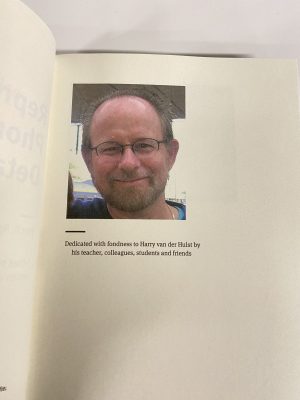
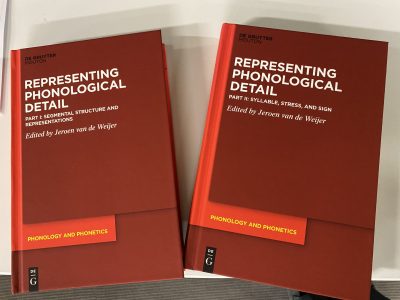
Harry van der Hulst was honored with a festschrift and special satellite workshop organized by Nancy Ritter at the Twelfth North American Phonology Conference (NAPhCxii), held at Concordia University, Montreal, Canada, May 14, 2023.

Harry also gave an invited presentation at the main conference titled What can stress tell us about the structure of synthetic compounds?


Presentations by current/former UConn affiliates included:

At the satellite workshop:

Aida Talic (PhD 2017, now at University of Illinois, Urbana-Champaign). Phases and accent assignment domains

Alexandre Vaxman (PhD 2016, now at University of Tours). Interaction of phonological and diacritic weight in hybrid accent systems

Rachel Channon. A new feature type: Functional features in sign languages

At the main conference:

Shengyun Gu, Diane Lillo-Martin and Deborah Chen Pichler (PhD 2001, now at Gallaudet). Phonological Development in ASL-Signing Children: Pseudosign Repetition


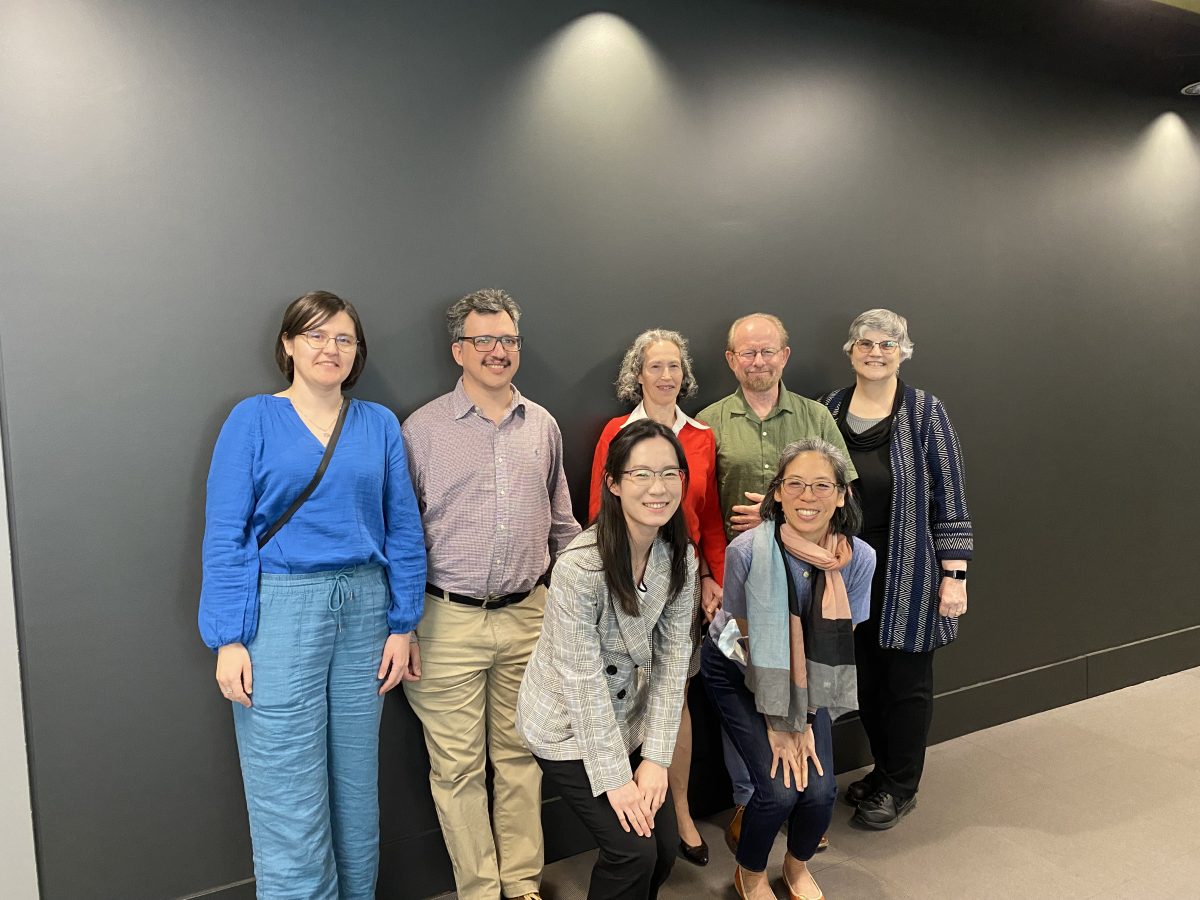
Photo: UConn affiliates at the workshop in person.

Front row: Shengyun Gu, Deborah Chen Pichler

Back row: Aida Talic, Alexandre Vaxman, Nancy Ritter, Harry van der Hulst, Diane Lillo-Martin

ECO5 at UConn

ECO-5 is an annual gathering of linguistics graduate students from five East Coast universities (UMass, MIT, Harvard, UConn, and UMD), and this year it is hosted by UConn Linguistics, taking place on February 25th. UConn Linguistics will also be represented at ECO-5 by:

  • Beccy Lewis. A deficient indexical in British English
  • Thanos Iliadis. The distribution of Modern Greek idhios

Tu+7 at UConn

We are pleased to announce that UConn Linguistics will be hosting the Seventh Workshop on Turkic and Languages in Contact with Turkic, otherwise known as TU+7, on February 18th-19th!

The program, abstracts, and information on registration can be found at: https://sites.google.com/uconn.edu/tu7

Please join us this year by registering by February 16th in order to receive updates and Zoom links for some fantastic talks!

NACCL-32 at UConn

The 32nd North American Conference on Chinese Linguistics (NACCL-32), organized by the UConn Department of Literatures, Cultures & Languages, is going to be held online on September 18-20. Several UConn linguists are going to be presenting at the conference:

  • Shuyan Wang. A Prosodic Analysis of Mandarin Classifiers
  • Shengyun Gu. Agreement verbs with weak hand classifier in Shanghai Sign Language
  • Xuetong Yuan & Hiroaki Saito. Matrix shuo in Mandarin
  • Yuanyuan Zhang & Chui Yi Margaret Lee. NPIs and their attenuation effects: Zenme ‘how’ as a case in Mandarin Chinese
  • Nick Huang (National University of Singapore/UConn), Annemarie van Dooren & Gesoel Mendes. Wanting the future: the case of desire and future ​yao
  • Nick Huang (National University of Singapore/UConn). Nominal expressions without nouns in Mandarin