Our department is pleased to announce the incoming graduate class for the 2024-25 academic year:
- Yao Lin
- Lydia Palaiologou
- Hiroaki Teraoka
- Heesun Yang
- Jiayi Zhou
Welcome! We’re looking forward to you joining us in the fall!
Our department is pleased to announce the incoming graduate class for the 2024-25 academic year:
Welcome! We’re looking forward to you joining us in the fall!
The article “Movement in disguise: Morphology as a diagnostic for verb movement in Algonquian”, by Ksenia Bogomolets (PhD 2020, now at Māori Language Commission & University of Auckland), Paula Fenger (PhD 2020, now at Leipzig University), and Adrian Stegovec, has just appeared online ahead of its print publication in the journal Syntax.
Abstract: This paper argues for a unification of two seemingly unrelated phenomena from unrelated language families: Verb Second in Germanic, and Conjunct versus Independent Order in Algonquian. It is argued that both reflect the possibility of the verb moving to C. While in Germanic this results in word order differences, in Algonquian V-to-C movement is detectable only via morphological alternations in agreement morphology. Under this view, Conjunct/Independent agreement and V2 are merely distinct reflexes of the same underlying process. This opens up new avenues of research in relation to V-to-C movement, framing it as a parametric option with potentially very different surface results in different languages depending on the setting of other parameters.
A special issue of The Linguistic Review on “Workspace, MERGE and Labelling”, guest edited by Victor Junnan Pan, Mamoru Saito and Yuqiao Du, was recently published (Volume 41, Issue 1, February 2024). The issue is the culmination of the Workshop on Workspace, MERGE and Labeling, which was held on August 7th, 2022 as part of GLOW in Asia XIII, hosted by the Department of Linguistics and Modern Languages at the Chinese University of Hong Kong. The papers in the issue are based on select talks presented at the workshop and main conference, and many of them are authored by current UConn linguistics faculty and alumni:
The 48th annual Penn Linguistics Conference took place on March 16-17 and UConn linguistics was represented at the conference with talks by:
Željko Bošković gave an invited talk at the Chinese University of Hong Kong on March 9th titled: Nominal and non-nominal subjects and adieu to the A/A’-distinction. More information on the talk can be found here.
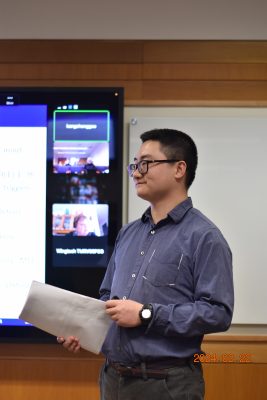
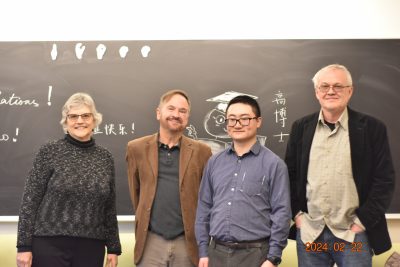
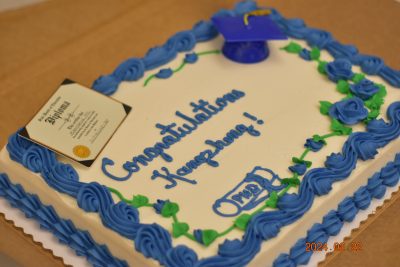
Kangzheng Gao successfully defended his doctoral dissertation titled A constraint-based approach to syntactic parameter-setting on February 22nd.
Congratulations, Kangzheng!
Kangzheng during the defense:
Dr. Gao with his committee after the successful defense:
Dr. Gao’s well earned cake:
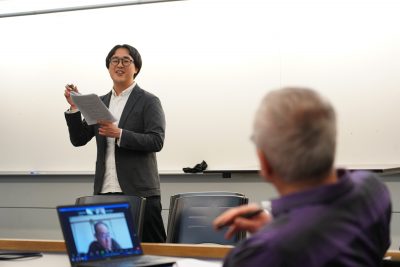
Yuya Noguchi successfully defended his doctoral dissertation titled Asymmetries, Covert Wh-Movement, and Nominality in Japanese Wh-Questions on February 5th.
Congratulations, Yuya!
Yuya during the defense:
Dr. Noguchi with his committee after the successful defense:
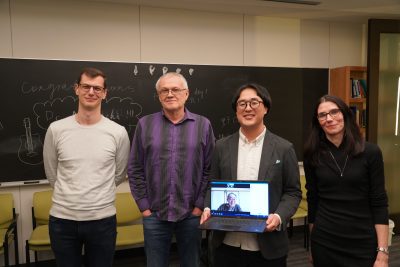
Dr. Noguchi cutting his well earned cake:

The 2024 edition of the Annual Meeting of the Linguistic Society of America took place January 4th-7th in New York City. The event also commemorated the centennial of the LSA. UConn linguistics was well represented at the conference with talks by:
… a poster presentations by:
… and a talk in the workshop on “Advances in the study of signed language phonological change”:
Magdalena Kaufmann‘s chapter “Imperative clauses” has been published as part of the book Wh-exclamatives, Imperatives and Wh-questions: Issues on Brazilian Portuguese (De Gruyter Mouton 2024, edited by Simone Guesser, Ani Marchesan and Paulo Medeiros Junior).
Abstract: This chapter introduces imperatives as the class of sentential form types in natural languages that are prototypically associated with the speech act of ordering. I show that imperatives serve for a crosslinguistically stable, but in itself diverse range of speech acts, which makes it challenging to find a common conventional core meaning that would explain the pattern. I discuss specific issues relating to the absence of intuitively accessible truth-values and restrictions on embedding. I then turn to a brief overview of syntactic assumptions about imperatives in general, before considering the status of grammatical categories like subject marking, tense and aspect, and negation in imperative clauses in more detail. Finally, I consider instances of imperative marking as occurring in embedded positions, as well as form types appearing in similar and typically smaller ranges of related functions.
Magdalena Kaufmann‘s paper “From Coherence Relations to the Grammar of Pronouns and Tense” has just appeared in Vol. 23, No. 69 of the Croatian Journal of Philosophy.
Abstract: Stojnić (2021) argues that the content of linguistic utterances is determined by the rules of natural language grammar more stringently than what is generally assumed. She proposes specifically that coherence relations are encoded by the linguistic structures and determine what individuals count as most prominent, thereby serving as the referents of free (“demonstrative”) pronouns. In this paper, I take a close look at the empirical evidence from English and Serbian that she offers in support of this position. Considering these data points in connection with additional linguistic data (also from German and Japanese), I argue that there is no compelling evidence for the assumption that coherence relations directly determine the resolution of pronouns. Instead, grammatical restrictions imposed by different types of pronouns and tenses have a larger impact on the meaning conventionally expressed by complex utterances than what is generally assumed in the literature on coherence relations.