Magdalena Kaufmann and Stefan Kaufmann presented work on Varieties of Fakeness at the University of Potsdam, Germany, on July 3.
UConn at CLS
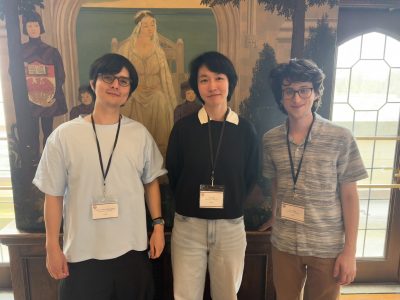
Jenkins Defense
Robin Jenkins successfully defended his dissertation on Comparative explorations in the middle-field.
Congratulations, Robin!
Lillo-Martin elected to AAAS
Diane Lillo-Martin was elected by the American Association for the Advancement of Science to its 2025 class of fellows. Congratulations, Diane!
Tsinghua Workshop on Modality in Logic and Language
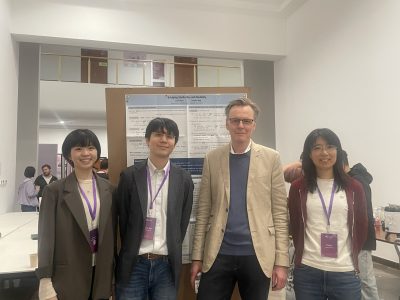
Chen | NLLT & LI
Qiushi Chen had a very successful two months with getting two papers published in NLLT and LI respectively.
The first article “Scrambling in the nominal domain: Evidence from the Chichewa DP” has appeared online in February ahead of its print publication in Natural Language & Linguistic Theory. The online version can be found here.
Abstract: Chichewa DPs are noun-initial and the modifiers following the noun may occur in any order. Assuming that Chichewa nouns invariably undergo N-to-D movement and that a universal structural hierarchy of the modifiers maps into left-to-right linear order (e.g., Dem ≫ Num ≫ Adj), this paper argues that the order flexibility of nominal modifiers in Chichewa involves scrambling of the modifiers, whose landing site is a position that does not involve a canonical Spec-head featural relation. Two data patterns are discussed: (i) Novel ellipsis data show that while a structurally higher modifier may license the ellipsis of a lower modifier, the reverse does not hold, even though the relative linear order between the modifiers is free; (ii) an asymmetry is attested regarding hybrid concord, in that a structurally higher modifier of a hybrid noun may show semantic concord while a lower modifier shows morphological concord, whereas the reverse pattern is not possible. After a brief comparison with two alternative analyses of the order flexibility, namely Cinque 2005 and Carstens 2008, 2017, the paper concludes that the Chichewa facts are overall best captured by the scrambling account. It thus confirms that scrambling is not just a clause-level phenomenon; it also exists in the nominal domain.
The second article “Discontinuous DPs, Wh-in-Situ, and Lower Copy Pronunciation in Chichewa” appeared online in March ahead of its print publication in Linguistic Inquiry. The online version can be found here.
Abstract: This paper offers a lower copy pronunciation account of two underexplored issues in Chichewa: wh-in-situ and discontinuous DPs. First, it is shown that Chichewa wh-in-situ is island-sensitive, and thus is best analyzed as a hidden case of wh-movement in narrow syntax, with the lower, postverbal copy of the wh-element pronounced. Second, discontinuous object DPs involve total dislocation of the entire object in syntax; at PF, the phonological features of its copies are deleted in a distributed manner, resulting in surface discontinuity. The study provides novel empirical evidence that supports the conceptually desirable idea that, for reasons of modularity, lower copy pronunciation is conditioned solely by PF factors, since it is shown that lower copy pronunciation in Chichewa, which is identified in both wh-in-situ and DP splits, results from a PF requirement. The requirement in question is further suggested to be associated with the residual conjoint/disjoint alternation in Chichewa syntax, which is not easy to see since the disjoint marker got lost morphologically, as a result of a diachronic change.
Double congratulations Qiushi!
UConn Linguistics at GLOW in Asia
The 2nd Workshop for Young Scholars edition of GLOW in Asia took place in Nagoya, Japan on March 13-15th, hosted by the Center for Linguistics at Nanzan University. UConn linguistics was represented at the conference with an invited talk by:
- Daiko Takahashi (PhD 1994, now at Tohoku University). Sluicing in Disguise
… a main session talk by:
- Qiushi Chen. Accidental gaps and agreement in Hokkaido Ainu
… and posters by:
- Ryuta Ono. Wh-scope marking via prosody and partial wh-movement in Japanese
- Hiroaki Saito (PhD 2023, now at Mie University). Attitude shift and the left periphery in Japanese
Lee Defense
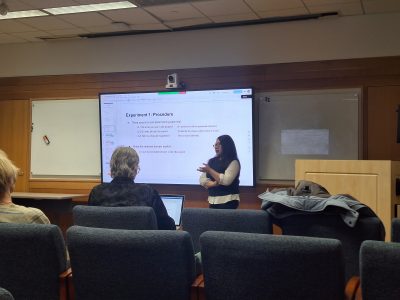
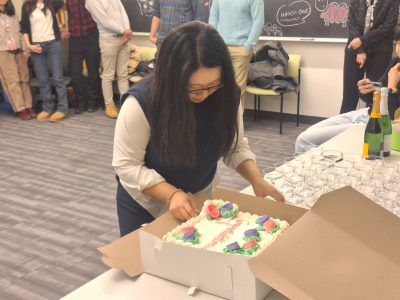
Chui Yi (Margaret) Lee successfully defended her doctoral dissertation titled How Do Children Acquire Definiteness? An Acquisitional Study of English- and Cantonese-acquiring Children on February 6th.
Congratulations, Maggie!
Maggie defending:
Dr. Lee cutting the first slice of her well-earned cake:
UConn Linguists at the LSA Annual Meeting
The 2026 edition of the Annual Meeting of the Linguistic Society of America took place January 8-11 in New Orleans. UConn linguistics was well represented at the conference with talks by:
- Qiushi Chen. On fission and the cycle: Lessons from Japhug agreement
- Helen Koulidobrova (PhD 2012, now at Central Connecticut University), Julio v. Aguirre, Jorge Banet, Fernanda v. Bossano. Steps in Collaborative Documentation of Ecuadorian Sign Language (LSEC)
- Yixuan “Pepper” Yan. Presupposition of alternative questions: The view from child Mandarin
- Emily Jo Noschese and Diane Lillo-Martin. Noun Phrases with Multiple Adjectives in American Sign Language
- Seungho Nam, Seo-young Lee and Se Yeon Park. QUD sensitivity as a parameter of presupposition triggers: Evidence from Korean
- Bonnie Barrett, Linghui “Eva” Gan, Deborah Chen Pichler (PhD 2001, now at Gallaudet University) and Diane Lillo-Martin. L2 Grammatical Development of ASL by Hearing Parents of Deaf Children
- Margaret Chui Yi Lee. Do children exhibit consistent patterns across different uses of definites? A case study of Hong Kong Cantonese-speaking children
… a poster presentations by:
- Troy Messick (PhD 2017, now at Rutgers University). Pronoun and Anaphor (non)complementarity in PPs: A view from coordinated reciprocals
- Troy Messick and Merlin Balkhash. Indexical and agreement shifting in Kazakh
- Jeremy Johns and Helen Koulidobrova. Where Indigenous language revitalization and dominant L2 instruction meet: converging on the Indigenous pedagogy
In addition, Qiushi Chen was a recipient of the Centennial Student Scholarship Award. Congratulations!
Wang | Language and Cognition
Shuyan Wang (PhD 2022, now a post-doc at UConn) has published an article co-authored with Shaohua Fang in the journal Language and Cognition, titled “L2 Interpretation of Quantifier Scope: Influence of Individual Difference Factors“. Congratulations Shuyan!
Abstract: This study investigated L2 learners’ interpretation of quantifier scope, focusing on the influence of individual differences, including L2 proficiency, working memory (WM) and inhibitory control (IC). A picture selection task using the covered-box paradigm (CBP) was conducted with 70 Chinese-speaking learners of English and a control group of 40 native English speakers. The results revealed that inverse scope (IS) posed particular challenges for L2 learners, leading to reduced, non-target-like access. We attribute this difficulty to factors such as negative L1 transfer, limited L2 input and increased processing demands associated with IS compared to surface scope (SS). More importantly, WM and IC significantly influenced L2 learners’ interpretation patterns, with their effects mediated by L2 proficiency. We also observed individual variation in scope interpretations among native speakers, particularly with negatively quantified (NQ) sentences. This variation provides valuable evidence of individual differences in native speakers’ grammatical knowledge and was partly driven by cognitive factors. Altogether, the findings contribute novel evidence for both domain-general and domain-specific mechanisms underlying quantifier scope interpretation in L2 learners as well as in native speakers.